BoundedNews
If you grew up with a ration card in the house, you know the drill. One day the dealer is everyone’s “chacha ji,” smiling and saying, “Aa gaya chawal, line mein lag jao.” Next month, same dealer: “Stock nahi aaya, system mein dikha hi nahi.” You go home with vibes and excuses. No grain.
This site is for that exact gap — between “government is giving free ration” in speeches and “aaj bhi khaali haath wapas aa gaye” in real kitchens. In Jharkhand, PDS scams are not just one big headline; they’re a series of small thefts that add up: dealers black-marketing grain, Aadhaar glitches blocking genuine people, and biometric machines becoming gatekeepers instead of helpers.
And if you’re between 18 and 25, here’s the cruel joke: it’s usually your generation that has to fight both the offline ration dealer and the online OTP system while elders just want to know, “Mahine ka anaaj mila ki nahi?”
THE THING NOBODY ACTUALLY SAYS OUT LOUD
Nobody on TV will say it plainly, so let’s do it here: the PDS ration scam in Jharkhand isn’t just “some corruption by a few bad apples.” It’s a system carefully arranged so that when things go wrong, the poorest people lose food, and everyone else loses… nothing.
Take one recent case from Potka in Jamshedpur district. A PDS dealer was found to have withheld rations from 203 families for three months — November, December, and January while about 135 quintals of grain meant for them was allegedly black-marketed. The market value was roughly ₹5 lakh, and only after an inquiry was the dealer suspended and ordered to distribute the pending grain within a week, with a threat of license cancellation and criminal action if he failed. That’s not a “small irregularity.” That’s literally food for 203 households turned into profit.
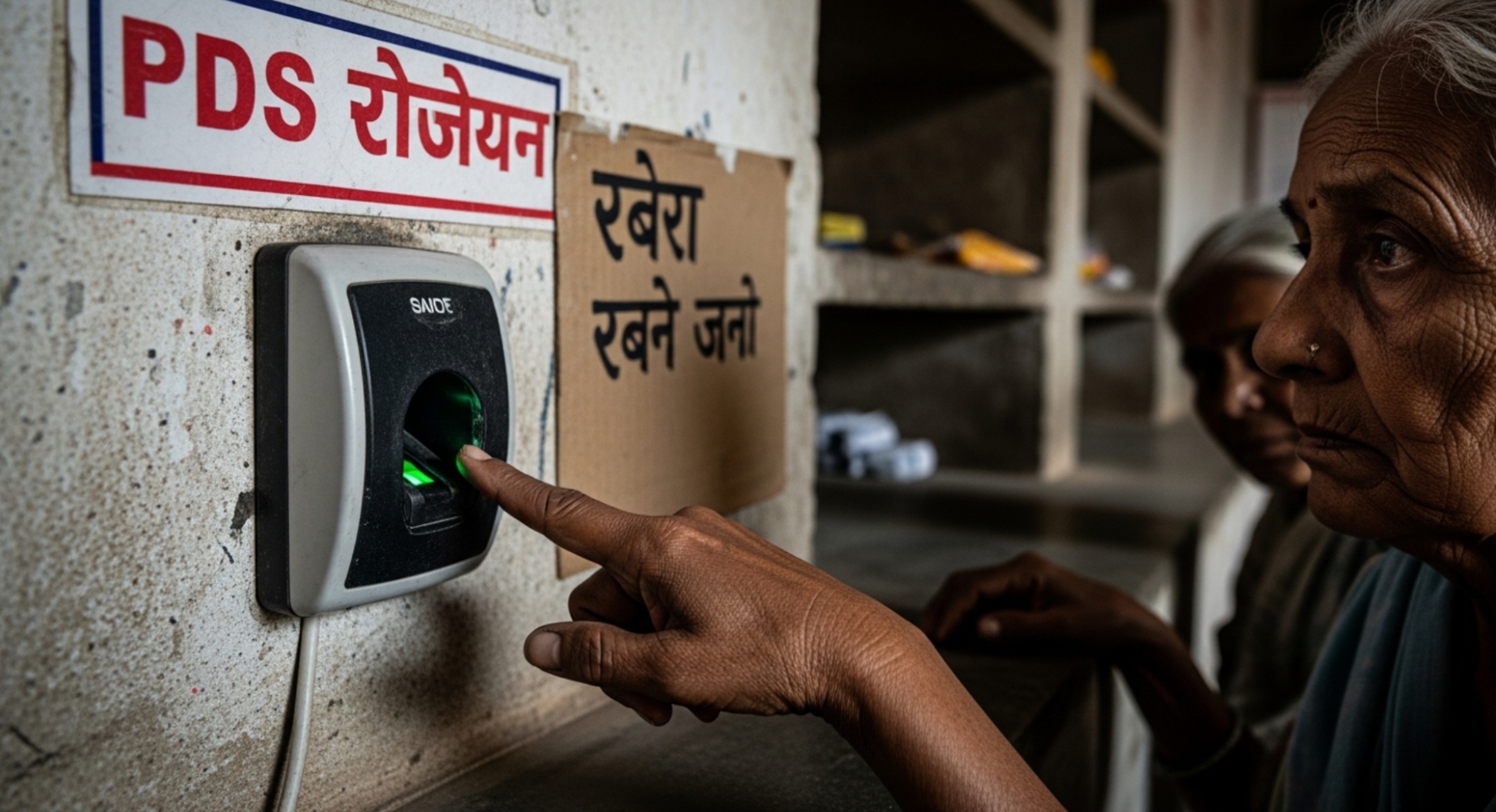
Then there’s the modern scam flavour: tech-enabled denial. Years of Aadhaar-based biometric authentication and e-PoS machines were sold as solutions to leakages. Right to Food activists and journalists have documented multiple cases where fingerprints were taken on the machine, transaction recorded as “successful”, but ration never handed over — dealers simply kept the grain and played hide-and-seek later. Imagine scanning your thumb, seeing “transaction successful” on the screen, and still going home to explain to your mother why the ration bag is empty.
Jharkhand has seen something even darker: starvation deaths linked to Aadhaar-PDS disruptions. Activists highlighted at least seven deaths where ration cards were reportedly cancelled for not being linked with Aadhaar, or where repeated biometric failures blocked access to grain. In one case, Usha Devi’s fingerprint could not be authenticated; online records showed ration allotted to the dealer, but the family didn’t receive it because the dealer claimed lack of stock. The grain existed — just not in their kitchen.
The real scam is this: Jharkhand’s PDS uses technology that punishes the poor for glitches they didn’t create, while leaving plenty of room for dealers and officials to quietly siphon off grain. You get exclusion plus corruption — peak combo.
If you’re thinking this sounds like that one college group project where one person does all the work and some guy still gets full credit, you’re not wrong. Except here, the “marks” are rice and wheat, and failing can literally mean someone goes hungry.
HOW THIS ACTUALLY WORKS THE REAL MECHANICS
Let’s decode the PDS scam in Jharkhand in actual mechanics, not boring governmentese.
Basic idea: the Public Distribution System (PDS) gives subsidised food grains — rice, wheat, sometimes pulses — to ration card holders, especially Priority and Antyodaya households. The State lifts grain from FCI godowns, moves it to district godowns, then to Fair Price Shops (FPS), where dealers distribute it to cardholders after authentication. Sounds simple. Till you throw Aadhaar, biometrics, and local power politics into the mix.
Here’s what the last decade did:
Jharkhand digitised ration cards, seeded them with Aadhaar, and made biometric authentication at e-PoS machines mandatory in most places. Later, some processes like changing card details started requiring Aadhaar-linked OTPs as per a 2024 PDS control order. The official logic: stop “bogus” cards and ghost beneficiaries, plug leakages, and target subsidies better.
What actually happens on the ground is:
- Authentication failure becomes exclusion
When fingerprints don’t match — worn-out fingerprints, faulty devices, poor connectivity — genuine people are turned away. Right to Food campaigns have shown cases where elderly or manual workers repeatedly failed authentication and were denied rations while records still showed grain lifted on their names. - OTPs create a new gate
To add members or make changes to ration cards, Jharkhand’s 2024 control order added Aadhaar-linked OTP as a step, without clearly explaining the need. Many poor households don’t have consistent phone access, SIM in their own name, or network in their village. So “update your card” becomes an upper-middle-class difficulty level task. - Dealers game the digital gap
Reports from Jharkhand show dealers separating authentication and distribution — taking fingerprints now, promising grain “later,” then tampering with digital records to hide undelivered stock. It’s like ordering food online, getting the “delivered” notification, but the delivery guy quietly ate it on the way. - Supply chain opacity stays
Caravan and other outlets have documented how the old problems — power imbalance between FPS dealers and villagers, lack of transparency in stock levels, weak grievance redressal — continue despite digitisation. Aadhaar didn’t fix that; it just added new points where the system can say “computer says no.” - Accountability is rare and reactive
When 203 families in Potka were denied ration for three months and 135 quintals of grain was allegedly diverted, strong action came only after an investigation and public reporting. Suspension, re-tagging of cards to another dealer, threats of license cancellation and criminal cases — all that is reactive, not built into daily monitoring.
Quick list, with opinions baked in:
- Aadhaar-based biometric PoS
Good idea on PowerPoint, terrible when your fingerprint is worn out from manual labour and the machine can’t see your existence. - OTP-based changes to ration cards
Claims “security,” often means poor people need a smartphone or a helpful middleman to do even basic corrections. - Dealer control over both tech and grain
When one person controls the machine login, the stock, and the narrative, the balance of power is obvious. - Starvation deaths linked to Aadhaar-PDS
Proof that “technical” decisions are actually life-and-death for the poorest. Activists pointed to at least seven such deaths and took the matter to the Supreme Court. - Loud anti-corruption talk, quiet exclusions
Politicians love saying “no leakages now, everything is digital.” Grassroots investigations keep showing that digitisation has often compounded both leakages and exclusion in Jharkhand’s PDS.
If you’ve ever had a college admin say “the portal is not working today, come tomorrow,” you already understand the structure. Now imagine that, but instead of an exam form, it’s your rice for the month.
COMPARISON WHAT’S ACTUALLY DIFFERENT BETWEEN YOUR OPTIONS
If your family is stuck in Jharkhand’s messy PDS, these are basically your real-world “options.”
| Option | What it actually does | Who it’s for | The catch |
| Accept biometric + OTP hurdles and keep chasing ration | You keep going to the FPS, trying fingerprints, OTPs, and card updates till things work; fight small battles case by case | Families with at least one younger member who can handle phones, forms, and arguing with dealers | Stressful, time-consuming; you still face tech failures and dealer misuse, and every month is a new gamble |
| Push back using complaints, Right to Food networks, and local media | You document denial, contact activists, file complaints, demand inquiries; sometimes get dealers suspended or grain released | Households with support from local organisations, students, teachers, or activists who know the system | Slow, uneven results; needs persistence and some social capital, and doesn’t fix the entire PDS around you |
| Rely less on PDS and more on market/other schemes | You reduce dependence on ration, lean more on market purchases, MNREGA wages, pensions, or private charity | Slightly less-poor families, or those with migrants sending money from cities | Food costs shoot up; the poorest can’t actually choose this without cutting meals or nutrition |
My take: option two organised pushback is the only one that has a chance of changing anything beyond your own kitchen. Surviving the scam is different from shrinking it.
WHAT ACTUALLY HAPPENS WHEN YOU TRY THIS
When you actually try to get ration in a scam-prone PDS setup in Jharkhand, it feels less like a welfare scheme and more like a monthly exam you didn’t sign up for.
You go with your ration card, maybe with your mother or grandmother. The dealer has an e-PoS machine. Step one: biometric. For younger fingers, it usually passes. For an older woman who’s done manual labour or cooking for years, fingerprints can be faint. When it fails, the machine beeps, and depending on the village, one of two things happens either they try again, or the dealer shrugs and says, “System nahi le raha.”
If your biometric passes, you think you’re safe. Not always. There are documented cases where fingerprints were authenticated, online records showed ration “delivered,” but the dealer didn’t actually give the full quota. Sometimes they say, “Aadha kal lena,” sometimes “stock nahi aaya,” sometimes nothing. The family doesn’t always argue hard; there’s a power dynamic, and people are tired. You walk back with less grain than you’re entitled to, and the system counts it as fully given.
What nobody warns you about here is the emotional whiplash of digitisation. Older people who once dealt with a physical ration card and a handwritten register now depend on e-PoS machines, OTPs, and online records they can’t see. They are told that corruption has reduced “because of Aadhaar,” while their lived experience is: more steps, more failure points, and very little accountability when something goes wrong.
Then there are the horror cases that make it to media — starvation deaths where families had ration cards cancelled because they weren’t linked with Aadhaar, or where months of biometric failures cut off grain while dealers still showed stock lifting online. Right to Food campaigners describe visiting families where the ration card was inactive, no PDS grain had come for months, and a death forced everyone to pay attention. Those are the extreme edge of the same pattern.
A pattern most articles skip: PDS scams are not one thing. They’re layers.
- Old-school corruption: dealers diverting grain, cutting weights, doing black marketing.
- New-school exclusion: Aadhaar failures, OTP hurdles, digital records that tell a different story from the kitchen.
- Weak response: panels formed after deaths, reports not notified, recommendations not implemented quickly.
By the time you notice how all of this fits together, you’ve already seen the same story repeat different village, same excuse.
THE ADVICE EVERYONE GIVES VS WHAT ACTUALLY WORKS
Let’s tear apart some popular “solutions.”
- “Aadhaar se sab theek ho jayega, bas log adapt nahi hue.”
This is the favourite line of people who never had their ration card cancelled because some server didn’t sync. Evidence from Jharkhand is brutal: Aadhaar-based biometric authentication has failed to stop leakages and has instead created new barriers to ration access. Starvation deaths and large-scale exclusions have been linked to Aadhaar glitches and forced seeding. What actually works is designing tech as an option — allow offline or alternative verification when the machine fails, instead of treating the device as more real than the person. - “If you don’t get ration, just complain to the department.”
In theory, yes. In practice, most families don’t know where to complain, how to frame it, or what evidence to keep. They’re dealing with daily survival, not blog-writing. Right to Food campaigns, social audits, and media reports have shown that complaints only really move when activists, student groups, or local journalists amplify them. The realistic alternative: treat complaint as a team sport — involve local organisations, document everything (dates, names, how much grain denied), and push it through multiple channels. - “PDS toh fully digital hai, scam ka zamana gaya.”
If anything, digitisation has given scams better cover language. You now have “server down,” “Aadhaar not linked,” and “OTP nahi aaya” as new ways to block people. Caravan’s reporting from Jharkhand found that Aadhaar and digitisation compounded the earlier issues power imbalance, lack of transparency, weak oversight instead of erasing them. What works better is combining digitisation with independent audits, door-to-door checks, and public transparency of stock and transaction data in language and formats people can understand. - “If the system is so bad, people should just buy from the market.”
This is like saying, “If the mess food is bad, just order out daily” to a broke hostel kid. Many PDS households in Jharkhand simply cannot afford market rates if ration stops — that’s the whole point of a subsidised system. Cases of alleged hunger deaths are usually about people who had no buffer left when PDS failed — no savings, no big income, nothing to fall back on. The honest alternative here is not “leave PDS,” it’s “fix PDS and widen safety nets.”
This is the part where you decide whether you want feel-good answers or ones that match reality. The second kind is annoying, but at least you can do something with it.
THE PRACTICAL PART WHAT TO ACTUALLY DO
You can’t personally clean up Jharkhand’s PDS (unless you’re secretly the Food Secretary, in which case… hi). But you can stop being a passive extra in this scam.
- If your family uses PDS, start tracking every month like a ledger.
Note the date you got ration, quantity actually received, and any excuse the dealer gave if something was short. Over a few months, patterns pop out — “server down,” “stock nahi aaya,” or biometric drama. That turns vague anger into concrete evidence. - Learn the basic rights language — and use it at the shop.
If you or a sibling is the “educated one,” know that ration quantities, rates, and grievance contacts should be displayed at the FPS. Next time something feels off, ask in clear words: “Stock ki entry online mein kya dikha raha hai? Complaint register kahan hai?” A lot of dealers relax when they realise nobody knows their rights. You don’t have to shout; just showing you know the rules changes the power equation. - Connect with Right to Food groups and local activists.
Jharkhand has a strong Right to Food network that has already taken Aadhaar-PDS cases to the Supreme Court and documented starvation deaths. Following their work, contacting them with detailed cases, or attending even one public hearing can plug you into a support system much bigger than your own lane. - Use your “youth skill set” — phones, socials, language — for your people.
You already know how to record videos, write a caption, or send an email better than most older villagers. If your local PDS shop is repeatedly cheating, document it thoughtfully — dates, cards, responses — and send it to local media, activists, or district authorities. Don’t just dump angry reels on Instagram; aim them where they can actually create pressure. - Push for alternatives, not just “jugaad,” in conversations.
Whenever Aadhaar-PDS problems come up in your circles, don’t let the solution stop at “try again next month.” Bring up examples where mandatory biometrics and OTPs caused exclusion and deaths. Talk about the idea of fallback methods: offline verification, relaxed rules for elderly/disabled, regular audits. Normalising these demands is step one. - If you’re in college or law/policy/tech, make this a project once.
Pick one block, study its PDS — card cancellations, Aadhaar issues, dealer behaviour, grievance system. Turn it into a paper, a report, a documentary short, anything. You’ll understand both governance and injustice better than half your syllabus ever will. - Don’t let “digital reform” pass unquestioned
Every time some big speech promises a new PDS tech reform face auth, app-based tokens, whatever — ask: what happens when it fails, and who carries that cost? Jharkhand already showed that Aadhaar-based digitisation can compound exclusions instead of fixing leakages. That lesson shouldn’t be forgotten the next time a shiny new idea appears.
QUESTIONS PEOPLE ACTUALLY ASK
What is the PDS ration scam in Jharkhand exactly?
It isn’t just one case. It’s a mix of dealers diverting grain, cutting rations, and using Aadhaar-based systems in ways that block genuine beneficiaries. Cases like Potka, where a dealer allegedly withheld rations from 203 families for three months and black-marketed about 135 quintals of grain, are the visible tip. Underneath that are quieter scams: showing rations delivered in the system while people go home half-empty.
How is Aadhaar linked to PDS problems in Jharkhand?
Aadhaar was made mandatory for PDS in Jharkhand through seeding and biometric authentication at ration shops. When fingerprints don’t match, networks fail, or cards aren’t linked, people get excluded even if they have valid ration cards. Activists have linked several starvation deaths to Aadhaar-related disruptions and took these cases to the Supreme Court. On top of that, a 2024 PDS control order added Aadhaar-linked OTP steps for card changes, making access even more complex.
Have there been starvation deaths linked to PDS issues in Jharkhand?
Yes. Right to Food campaigners in Jharkhand have documented multiple deaths where families went without ration due to Aadhaar-linked problems or card cancellation, while officials often disputed “hunger” as the cause. In one widely discussed case, an 11-year-old girl, Santoshi Kumari, allegedly died of starvation after her family’s ration card was not linked properly. These incidents pushed the Supreme Court to hear petitions on starvation deaths in the state.
What happened in the Potka PDS scam case?
In Potka’s Gwalkata panchayat, an investigation found that a PDS dealer had not given ration to 203 cardholders for three months while around 135 quintals of grain meant for them was allegedly diverted. The district supply officer suspended the dealer and the associated women’s group, ordered that pending grain be distributed within a week, and warned of license cancellation and criminal proceedings if that didn’t happen. The affected families were temporarily tagged to another dealer so they could start getting ration again.
Does digitisation reduce PDS corruption in Jharkhand?
Evidence so far says: not automatically. Field reports from Jharkhand show that Aadhaar linkage and digitisation of the PDS supply chain have not eliminated corruption or leakages. Instead, they have introduced new issues like biometric failures, OTP hurdles, and ways for dealers to tamper with digital records while still denying grain to people. Without strong accountability and offline backup systems, digitisation often shifts the pain to the poorest users.
How many people depend on PDS in Jharkhand?
Jharkhand has around 2.5 crore PDS beneficiaries, according to Right to Food groups and social media campaigns highlighting proposed large-scale deletions. That means a huge part of the state’s population relies on subsidised grain for basic food security. When systems fail whether through tech glitches or scams the impact is immediate and widespread.
Why don’t people just complain if ration is denied?
Some do, but the system is intimidating and slow. Many PDS users don’t know the formal complaint path or feel powerless against dealers who are politically connected or considered “important” in the village. Complaints often move only when Right to Food activists, media, or civil society groups get involved and document the violations in detail. For a family barely managing food, navigating bureaucracy is a huge extra burden.
What role can young people play in fighting PDS scams?
You can help document denial cases, explain processes to elders, and link your community to activist networks. Using your phone for evidence photos of notices, videos of repeated denial, screenshots of SMS records can make a big difference when taking a case to authorities or media. Even learning and spreading the basic rules of PDS rights in your village or area helps cut down how easily dealers can lie.
SO WHERE DOES THIS LEAVE YOU
So we’re here: a state where ration is “digitally reformed,” yet you still have people in Jharkhand dying after months of failed access to food grains, and dealers caught sitting on hundreds of quintals meant for poor families. On one side, PowerPoint slides and control orders; on the other, women quietly walking back from ration shops with empty bags.
The uncomfortable truth is that you, as an 18–25-year-old, can’t fix structural PDS corruption by yourself. You’re not going to personally rewrite Jharkhand’s PDS control order or rip biometric machines out of every shop. What you can do is smaller, but not useless: refuse to let “system error” be the end of the story in your circle.
One concrete thing you can do today: ask at home — “Iss mahine ration time pe mila tha? Kitna mila, aur kitna likha hai card mein?” If the answers don’t match, write it down. That’s where every real fight against this scam starts not on a panel, but in the small detail someone finally refuses to ignore.
CONCLUSION
If you made it till here, you’ve spent more time understanding Jharkhand’s PDS than many people who take policy decisions about it. Slightly depressing, slightly impressive. You’ve seen how a “ration scam” isn’t a one-time headline but a system designed so that machines and middlemen get more respect than hungry people.
The line to keep with you is simple: when tech and rules matter more than whether grain actually reaches a human stomach, that’s not reform that’s just a more sophisticated way to look away. Try not to be one of the people looking away.
Your opinion is important!
What are your thoughts on this news? Please rate our article using the Like or Dislike button and share your feedback in the comments section. Your thoughts and suggestions are extremely important to us and will help us provide better service. Thank you!